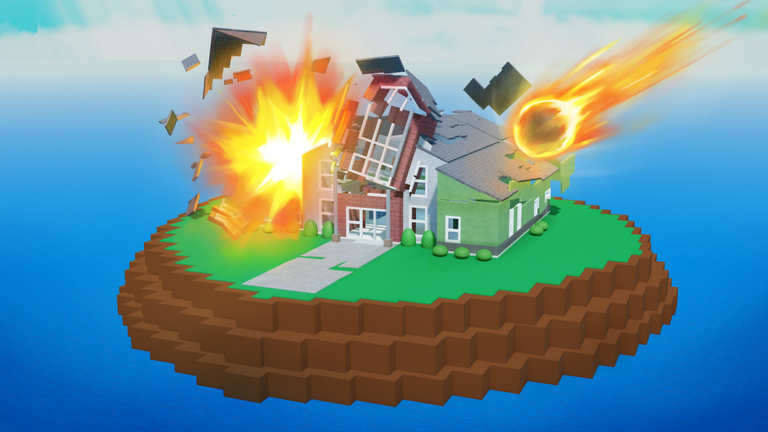
Natural Disaster Survival is all about quick reactions and clever movement. Disasters strike the map without warning, and you need to react fast to avoid them. It's simple to learn but challenging to master — every round tests your timing and positioning.
The game was created by Stickmasterluke and has become one of Roblox's most-played survival experiences. Millions of players keep coming back for the thrill of cheating disaster after disaster.
What Is Natural Disaster Survival?
This is a survival game where you spawn on a map with other players and face wave after wave of environmental hazards. Earthquakes, tsunamis, meteor showers, floods, and more appear randomly. Your job is simple: don't get hit. Players who get caught by the disaster are eliminated, and survivors advance to the next round.
There's no combat between players — you're all working against the environment. Teamwork can help, but ultimately, it comes down to your ability to predict where danger will hit and move away fast.
Your First Game: Step by Step
- Join a server. Click the "Play" button and wait for a match to start. You'll spawn with 10-50 other players depending on server size.
- Look at your surroundings. Take a few seconds to see where you are on the map. Note landmarks, open spaces, and high ground.
- Wait for the first disaster warning. The game will announce which hazard is coming next (you'll see text on screen or hear a sound cue).
- Move to safety immediately. Don't wait. Run, jump, or climb away from where the disaster is about to hit.
- Survive as long as possible. Keep reacting to each new disaster. If you're still standing after all rounds, you win.
- Check the leaderboard. At the end, you'll see your rank and stats. Play again to improve your survival time.
Core Game Loop
Every round follows the same pattern:
- You spawn on the map with other players.
- A disaster is announced (you get a few seconds' warning).
- The hazard appears and spreads across the map.
- You dodge it by moving to an unaffected area.
- If you're hit, you're out. If you survive, you advance to the next disaster.
- New disasters keep coming until only the strongest survivors remain.
The disasters vary — some affect the entire map, some only part of it. Learning what each disaster does and where it targets is key to staying alive longer.
Essential Controls
On PC:
- WASD — Move forward, backward, left, and right
- Space — Jump (spam it to gain height)
- Mouse — Look around and aim your camera
- Shift — Sprint (hold to run faster)
On Mobile:
- Left joystick — Move in any direction
- Jump button — Press the on-screen button to jump
- Camera joystick — Right side of screen, look around
On console, use the left stick to move and the right stick to look. A button or X to jump depending on your platform.
Common Beginner Mistakes
Freezing when a disaster is announced. New players sometimes panic and don't move. The moment you hear the warning, start running. Every second counts.
Staying in the center of the map. The middle is often the most dangerous zone. When disasters hit, they usually spread outward from there. Move to the edges or high ground instead.
Following the crowd blindly. Just because other players are running one direction doesn't mean it's safe. Think for yourself — look at the disaster and predict where it's heading.
Forgetting about vertical space. You can jump onto buildings, platforms, and structures. High ground is often safer than running on flat terrain. Use it whenever possible.
Running out of bounds. The map has edges. If you run too far off the map, you'll fall and die just like you would from a disaster. Stay within the playable area.
Early Goals and Tips
Your first goal: Survive 5 consecutive rounds. This teaches you how disasters work and helps you learn the map layout without pressure.
Next goal: Be one of the last three players standing. This means you're predicting hazards correctly and moving efficiently.
Advanced goal: Win a round (be the last survivor). This requires knowing the map well, reading disaster patterns, and having faster reflexes than everyone else.
Quick early tips:
- Never stay in one spot for long — move around the map to scout multiple escape routes.
- Watch the red zone indicators on the map (if available) — they show where danger is coming.
- If you're stuck between two hazards, jump vertically or onto a platform to avoid both.
- Teammates can help block hazards or warn you, but don't rely solely on them — stay alert yourself.
- Each disaster type has predictable behavior. After a few rounds, you'll anticipate where hazards spawn.