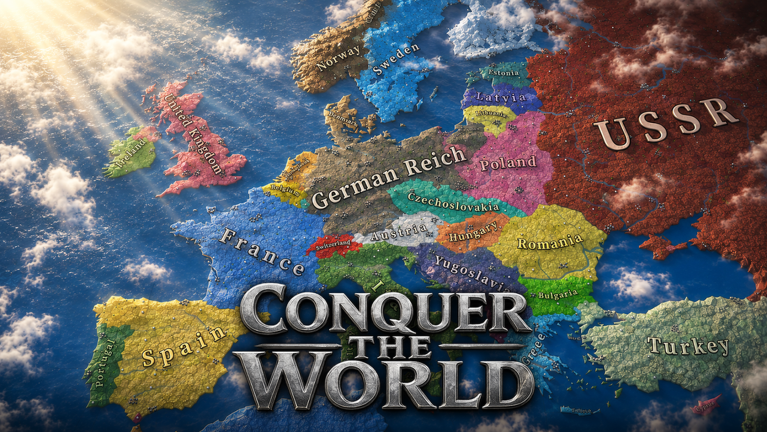
Conquer The World WW2 is a fast-paced strategy game where you lead a nation through warfare across multiple historical eras. You manage your economy, build armies, and capture territory to achieve world domination. It's designed to be quick and fun—think of it as a streamlined version of games like Hearts of Iron, but built for Roblox.
The game mixes military tactics, economy management, and territorial conquest. You'll make constant decisions about where to attack, what to build, and when to trade or ally with other players.
What Is Conquer The World WW2?
This is a nation-builder strategy game. You pick a country, manage its economy, raise an army, and fight to expand your borders across a global map. Over 200+ conquerable countries exist on that map, so there's always a target.
The game lets you play through three different eras: World War 1, World War 2, and World War 3. Each scenario resets the map and gives you a fresh start with the same core mechanics but different strategic situations.
Picking Your Nation
Your first choice is selecting which nation to lead. Different countries have different starting positions, borders, and neighbors. Some start strong with good resources and defensible borders. Others are surrounded by rivals and require more aggressive early strategy.
Think about where you want to expand. If you pick a nation in the center of a continent, you'll have many neighbors to fight. If you pick an island nation, you might have fewer immediate threats but will need naval capabilities to expand. For your first game, pick a nation with stable neighbors so you can learn the mechanics without constant pressure.
Your First Game Loop
Once you spawn as your nation, you'll see your territory and your current resources. The game loop repeats these steps every in-game tick or turn:
- Check your economy. How much money and resources are you generating per tick?
- Decide what to build or upgrade (factories, military units, tech).
- Check your neighbors. Which ones are weak? Which ones are allies?
- Move troops or attack if you're ready.
- Wait for the next tick and repeat.
The game moves quickly. You won't spend hours waiting—ticks happen regularly, so decisions come often. This keeps the action flowing and prevents downtime.
Building Your Economy
Your economy is everything. It generates the money and resources you need to train troops, research technology, and expand. Without a strong economy, you can't build a strong military.
Early on, focus on factories and industrial infrastructure. These buildings produce resources each tick. The more factories you have, the faster your economy grows. This is complex economy management—you'll balance production, trade, and spending throughout the game.
As you grow, consider specialization. Some nations might focus on fast resource production. Others might trade with allies to get specific resources. Experiment with different builds to see what works for your strategy.
Growing Your Military
Once your economy generates steady income, invest in troops. You train military units (infantry, tanks, aircraft, etc.) to build your army. Each unit costs resources and takes time to train.
The game includes deep troop micromanagement. You can position units carefully on the map, support them with other units, and coordinate attacks. This is the tactical combat part of the game.
Different unit types have strengths and weaknesses. Infantry is cheap and versatile. Tanks are powerful but expensive. Aircraft are fast. You'll mix and match depending on your economy and your enemy. Learning what counters what is key to winning battles.
Capturing Territory
Once you have an army, attack your neighbors. Click on a border territory you want to capture. Your units will fight the defending troops. If you win, the territory is yours and your border expands.
Territory gains you more resources and production. The more land you control, the more factories and economy you have. This is the empire expansion part—bigger land = bigger economy = bigger army.
Plan your attacks. Don't just attack random neighbors. Look for weak spots, isolated territories, or enemies already fighting someone else. Use brilliant tactics to win with fewer losses.
Advanced Mechanics
Puppet States: You can create puppet states from captured territory. A puppet is a nation you control but that acts somewhat independently. This lets you manage a larger empire without losing direct control of every tile.
Allies and Territory Support: Team up with other players. You can fight alongside your allies on their territory, helping them defend or attack together. Allies make you stronger but require trust and coordination.
Nuclear Arsenal: Eventually, you can research and deploy nuclear weapons. These are devastating tools for mass destruction. Developing nuclear capability is a late-game goal that can shift power dramatically. Use them wisely—they're a superweapon, not a constant tool.
Technology Research: As you play, you unlock new technologies that make your troops stronger, your economy faster, or give you new weapons. Plan your tech tree carefully to get the tools you need for your strategy.
Early Beginner Tips
Don't attack too early. Build your economy first. A bigger army from a strong economy beats a small army raised too fast.
Pick weak neighbors to start. Your first conquest should be easy. This gives you confidence and extra territory to grow from.
Manage your expenses. If you spend faster than you earn, you'll run out of money and can't train new troops. Balance growth with spending.
Watch your borders. Other players will attack you if you look weak. Keep enough troops on your border to discourage attacks, even while expanding elsewhere.
Make allies but stay aware. Alliances help, but remember other players have their own goals. Don't over-commit to one ally or you might miss opportunities.
Try different scenarios. WW1, WW2, and WW3 each feel different. Play through multiple scenarios to find which era fits your playstyle.